

Visited the Ajmer Sharif Dargah. It was a wonderful, well-coordinated trip. Everything went according to plan.
Temple Travel Guide
About Mount Kailash
Best time: Year-round
Flexible hours
Custom & group tours available
Expert planning support
About About Mount Kailash
Mount Kailash: The Sacred Abode of Lord Shiva
Mount Kailash is not just a majestic snow-covered mountain—it is one of the world's most revered spiritual destinations. Standing in the remote Himalayas of Tibet, this sacred peak has inspired faith, devotion, and pilgrimage for thousands of years. For millions of believers, Mount Kailash represents the divine meeting point where spirituality, nature, and eternal peace become one.
Known as the eternal abode of Lord Shiva in Hinduism, Mount Kailash also holds immense religious significance in Buddhism, Jainism, and the ancient Bon tradition. Revered as the "Navel of the World" and the spiritual axis connecting heaven and earth, the mountain symbolizes purity, enlightenment, and liberation.
Whether you are planning a Kailash Mansarovar Yatra or simply seeking to understand its profound spiritual importance, Mount Kailash offers much more than breathtaking landscapes. Its sacred aura, timeless legends, and unmatched spiritual energy make it a place unlike any other—a destination where faith transcends boundaries and every step becomes a journey toward the divine.
Spiritual Significance of Mount Kailash & Its Different Names
Mount Kailash is one of the few places in the world that is equally sacred to followers of Hinduism, Buddhism, Jainism, and the ancient Bon religion. This extraordinary mountain symbolizes harmony among different faiths, making it a unique center of global spirituality.
For Hindus, Mount Kailash is the eternal residence of Lord Shiva, where He meditates alongside Goddess Parvati. Buddhists revere it as the abode of Demchok (Chakrasamvara), representing supreme bliss and enlightenment. Jains believe that the first Tirthankara, Rishabhdev (Adinath), attained liberation near Mount Kailash. Followers of the Bon tradition regard it as the sacred seat of spiritual power and the center of their ancient religious beliefs.
Throughout history, Mount Kailash has been known by several revered names, including Mount Meru, Kang Rinpoche (Precious Snow Jewel), Gang Tise, Sumeru, and the Navel of the Earth. Each name reflects the mountain's timeless spiritual importance and the deep reverence it commands across cultures and civilizations.
Whether viewed as the home of Lord Shiva, the cosmic mountain of Buddhist philosophy, the sacred land of Jain liberation, or the spiritual center of the Bon faith, Mount Kailash continues to inspire millions of pilgrims every year. Its unmatched spiritual aura, ancient legends, and divine presence make it one of the holiest and most mysterious destinations on Earth.
Why Is Mount Kailash Known as the Axis Mundi of Earth?
Mount Kailash is regarded as one of the most sacred places on Earth, where spirituality and divine energy are believed to converge. Across multiple religions, it is revered as the eternal abode of Lord Shiva in Hinduism, Chakrasamvara (Demchok) in Buddhism, Lord Rishabhanatha (Adinath) in Jainism, and a sacred spiritual center in the ancient Bon tradition. For centuries, saints, monks, sages, and pilgrims have visited this holy mountain in search of enlightenment, inner peace, and spiritual awakening.
Many devotees who undertake the Kailash Mansarovar Yatra describe an extraordinary sense of calm, heightened awareness, and a deep connection with the divine. The mountain's serene atmosphere and untouched natural surroundings create an experience that is often described as life-changing.
The Meaning of Axis Mundi
Mount Kailash is famously known as the Axis Mundi, meaning the "Cosmic Axis" or the "Center of the World." According to ancient traditions, it serves as the spiritual pillar connecting heaven and earth, allowing cosmic energy to flow between the physical and divine realms. This belief has made Mount Kailash a universal symbol of balance, harmony, and higher consciousness.
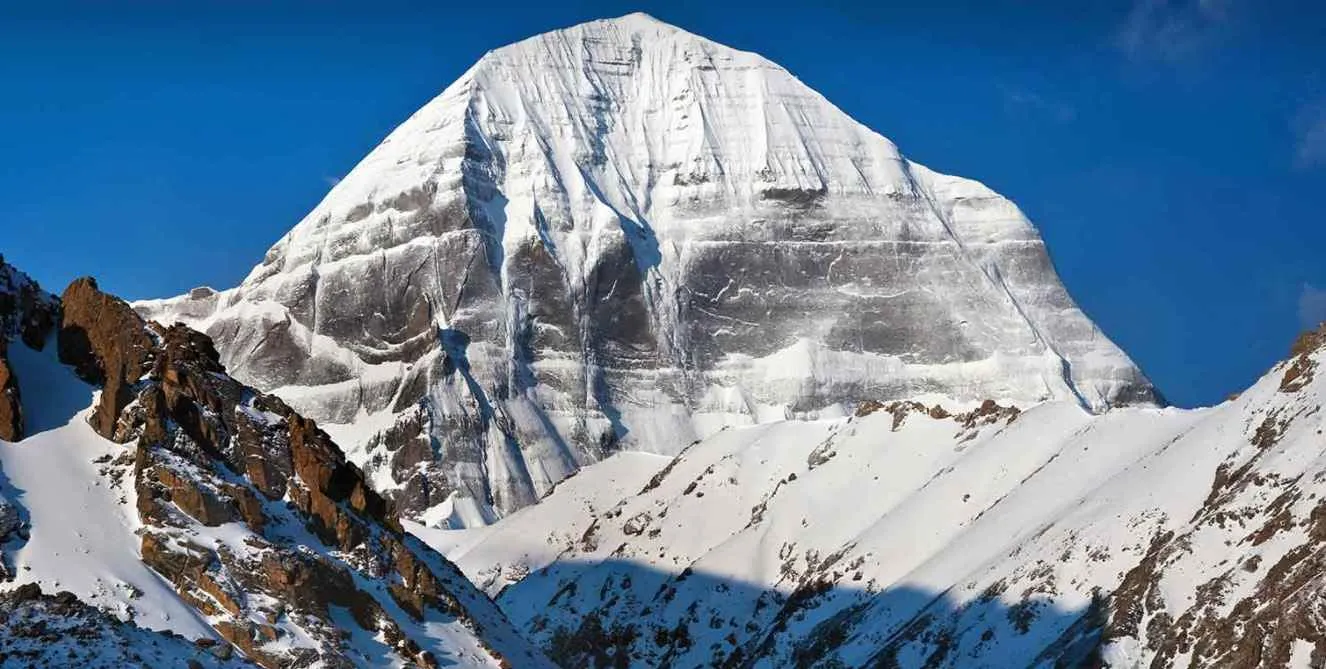
In Tibetan Buddhist philosophy, the mountain represents Samsara—the endless cycle of birth, death, and rebirth—while also symbolizing the path toward ultimate liberation and enlightenment. Its perfectly symmetrical, pyramid-like shape further strengthens its reputation as a natural monument of sacred geometry and cosmic significance.
The Sacred Landscape Around Mount Kailash
The spiritual importance of Mount Kailash extends beyond the mountain itself. It is surrounded by several holy sites, including Lake Mansarovar, Rakshastal Lake, the Lha Chu and Zhong Chu valleys, and the ancient monasteries of Dirapuk and Zuthulpuk. Together, these sacred landmarks form a spiritual mandala, with Mount Kailash standing at its center as a powerful symbol of divine light, purity, and universal consciousness.
A Place of Extraordinary Spiritual Energy
Many spiritual seekers, researchers, and pilgrims believe that Mount Kailash possesses a unique magnetic and spiritual vibration unlike any other place on Earth. While these experiences are based largely on personal faith and spiritual traditions rather than established scientific evidence, countless visitors report feeling a profound sense of peace, transformation, and inner awakening during their pilgrimage.
For this reason, the Kailash Mansarovar Yatra is considered much more than a physical journey. It is a sacred pilgrimage that offers devotees an opportunity to connect with one of the world's most revered spiritual destinations and experience its timeless atmosphere of faith, devotion, and self-discovery.
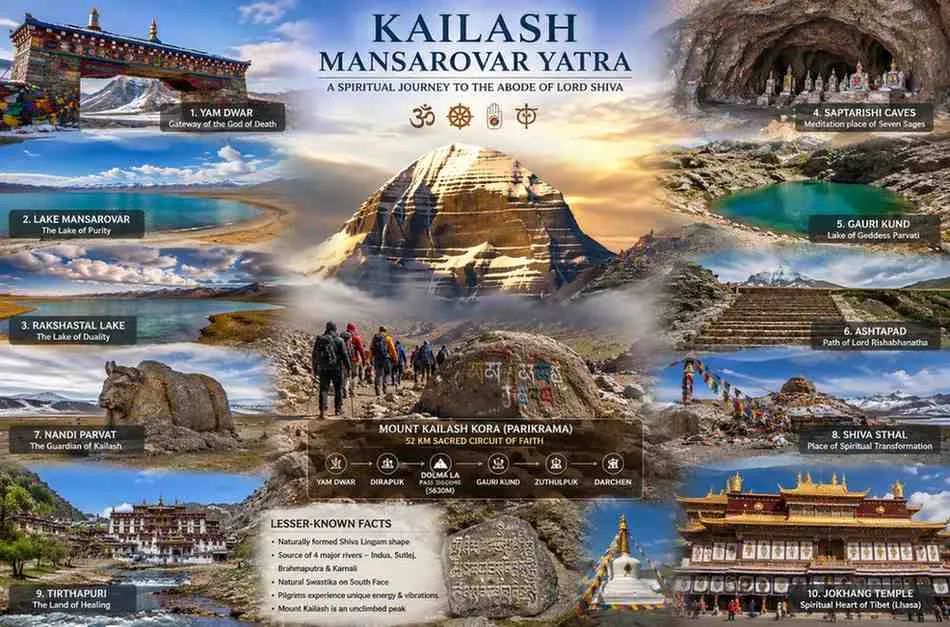
Kailash Mansarovar Darshan: Top 10 Sacred Places to Visit Near Mount Kailash
A pilgrimage to Mount Kailash is much more than reaching a sacred mountain—it's a journey through one of the world's most spiritually significant landscapes. The region surrounding Mount Kailash is home to ancient lakes, monasteries, valleys, caves, and sacred sites that have been revered for thousands of years by followers of Hinduism, Buddhism, Jainism, and the Bon religion. Each destination carries its own legend, spiritual significance, and unique energy, making the Kailash Mansarovar Yatra a truly life-changing experience.
1. Yam Dwar – The Gateway to the Divine
Also known as Chorten Kangnyi, Yam Dwar marks the official beginning of the Mount Kailash Parikrama (Kora). In Hindu belief, it represents the gateway of Yamraj, the God of Death. Pilgrims pass through this sacred arch as a symbolic act of leaving behind their ego, sins, and worldly attachments before beginning their spiritual journey. It is believed that only those with pure intentions receive the blessings to continue the sacred pilgrimage.
2. Lake Mansarovar – The Lake of Purity
Situated at an altitude of approximately 4,590 meters, Lake Mansarovar is among the highest freshwater lakes in the world. According to Hindu mythology, Lord Brahma created this divine lake through his mind, which is why it is called Manas (Mind) and Sarovar (Lake). Taking a holy dip or simply witnessing the tranquil waters is believed to cleanse one's sins and bring spiritual peace. Pilgrims also carry the sacred Mansarovar Jal back home as a symbol of divine blessings.
3. Rakshastal Lake – The Lake of Duality
Located beside Lake Mansarovar, Rakshastal is a crescent-shaped saltwater lake associated with King Ravana, who is believed to have performed intense penance here to please Lord Shiva. Unlike the calm waters of Mansarovar, Rakshastal appears mysterious and windswept. Together, the two lakes symbolize the eternal balance between light and darkness, purity and power, and the dual nature of existence.
4. Saptarishi Caves – The Meditation Retreat of the Seven Sages
Nestled along the Inner Kora route, the Saptarishi Caves are believed to be the meditation site of the legendary Seven Great Sages (Saptarishis). Surrounded by breathtaking Himalayan silence, these caves are considered one of the most spiritually powerful places near Mount Kailash. Pilgrims who reach this sacred location often describe experiencing deep peace and heightened spiritual awareness.
5. Gauri Kund – The Sacred Lake of Goddess Parvati
Located just below the Dolma La Pass, Gauri Kund is a beautiful emerald-green lake deeply connected with Hindu mythology. It is believed that Goddess Parvati (Gauri) created Lord Ganesha here using the turmeric paste from her body before breathing life into Him. For devotees, Gauri Kund represents divine motherhood, compassion, purity, and spiritual renewal after crossing the challenging Dolma La Pass.
6. Ashtapad – The Jain Pilgrimage of Liberation
Situated near Darchen, Ashtapad holds immense importance for the Jain community. According to Jain tradition, this is where the first Tirthankara, Lord Rishabhdev (Adinath), attained Moksha (Liberation). The peaceful surroundings make Ashtapad one of the holiest Jain pilgrimage destinations in the Himalayas.
7. Nandi Parvat – The Sacred Guardian of Kailash
Standing opposite the South Face of Mount Kailash is Nandi Parvat, whose natural shape resembles Nandi, the sacred bull and devoted vehicle of Lord Shiva. Just as Nandi guards every Shiva temple, this mountain is believed to stand as the eternal protector of Lord Shiva's divine abode.
8. Shiva Sthal – The Place of Spiritual Transformation
Shiva Sthal is one of the most emotionally significant stops during the second day of the Kailash Kora. Pilgrims traditionally leave behind a piece of clothing or another personal belonging as a symbolic act of surrendering their past sins, negative karma, and worldly attachments. This sacred ritual represents spiritual rebirth and the beginning of a purified life.
9. Tirthapuri – The Land of Healing
Located along the banks of the Sutlej River, Tirthapuri is famous for its sacred hot springs and the meditation cave associated with Guru Padmasambhava (Guru Rinpoche). Pilgrims visit this holy site to relax, heal, and seek blessings after completing the physically demanding Kailash Parikrama.
10. Jokhang Temple – Tibet's Most Sacred Temple
Although located in Lhasa, approximately 1,200 km from Mount Kailash, Jokhang Temple is considered the spiritual heart of Tibet. Home to the revered Jowo Shakyamuni Buddha statue, this UNESCO World Heritage Site is often the starting point of a pilgrim's spiritual journey before heading toward Mount Kailash.
What Is the Mount Kailash Kora (Parikrama)?
The Mount Kailash Kora, also known as the Kailash Parikrama, is the sacred circumambulation of Mount Kailash. The Tibetan word "Kora" means walking around a holy site as an act of devotion. For followers of Hinduism, Buddhism, Jainism, and Bon, completing this pilgrimage is believed to purify the soul, remove accumulated karma, and bring one closer to spiritual liberation.
The Outer Kora covers approximately 52 kilometres and usually takes three days to complete. The journey begins and ends in Darchen, passing through sacred landmarks such as Yam Dwar, Dirapuk Monastery, Dolma La Pass (5,630 m), Gauri Kund, Zuthulpuk Monastery, and numerous prayer-flag-covered valleys and ancient mani stones. Every step of the Kora is considered an act of prayer, faith, and inner transformation.
Lesser-Known Facts About Mount Kailash
Mount Kailash has fascinated pilgrims, explorers, and researchers for centuries. Here are some of its most remarkable features:
1. A Naturally Symmetrical Sacred Peak
Mount Kailash is renowned for its striking pyramid-like shape and nearly perfect symmetry. Many devotees believe it resembles a gigantic Shiva Lingam, surrounded by eight mountain ranges that form a natural lotus pattern.
2. Source of Four Major Rivers
The Kailash region gives rise to four of Asia's most important rivers—the Indus, Sutlej, Brahmaputra (Yarlung Tsangpo), and Karnali (a major tributary of the Ganges). These rivers sustain millions of people across India, Nepal, China, and Pakistan.
3. The Sacred Swastika Formation
The South Face of Mount Kailash features natural vertical and horizontal rock formations that resemble the ancient Swastika, a sacred symbol representing prosperity, harmony, and eternity in Hinduism, Buddhism, Jainism, and Bon traditions.
4. Reports of Unusual Experiences
Some pilgrims report experiencing unusual sensations during the Kailash Mansarovar Yatra, including changes in perception or the feeling that hair and nails grow more quickly. These accounts are based on personal experiences and spiritual beliefs rather than established scientific evidence.
5. The Unclimbed Sacred Mountain
Unlike most famous peaks, Mount Kailash has never been officially climbed. Out of deep respect for its religious significance, climbing the mountain is prohibited. Tibetan tradition also tells the story of the great yogi Milarepa, who is believed to have reached its summit through extraordinary spiritual powers.
Experience the Divine Journey
The Kailash Mansarovar Yatra is far more than a mountain expedition—it is a journey of faith, self-discovery, and spiritual awakening. From the sacred waters of Lake Mansarovar to the challenging Kailash Parikrama, every destination around Mount Kailash carries centuries of devotion, mythology, and timeless spiritual significance. For countless pilgrims, visiting these sacred places becomes a once-in-a-lifetime experience that leaves a lasting impact on the heart, mind, and soul.
History & background
Mount Kailash is not just a majestic snow-covered mountain—it is one of the world's most revered spiritual destinations. Standing in the remote Himalayas of Tibet, this sacred peak has inspired faith, devotion, and pilgrimage for thousands of years. For millions of believers, Mount Kailash represents the divine meeting point where spirituality, nature, and eternal peace become one. Known as the eternal abode of Lord Shiva in Hinduism, Mount Kailash also holds immense religious significance in Buddhism, Jainism, and the ancient Bon tradition. Revered as the "Navel of the World" and the spiritual axis connecting heaven and earth, the mountain symbolizes purity, enlightenment, and liberation. Whether you are planning a Kailash Mansarovar Yatra or simply seeking to understand its profound spiritual importance, Mount Kailash offers much more than breathtaking landscapes. Its sacred aura, timeless legends, and unmatched spiritual energy make it a place unlike any other—a destination where faith transcends boundaries and every step becomes a journey toward the divine.
FAQs
\n
\n
\n
\n
\n
\n
\n
\n
\n
\n
\n
\n
\n
\n
\n
\n
\n
\n
\n
\n
\nIndia (Government-organized Lipulekh or Nathu La routes, subject to approval)
\n11. Can senior citizens undertake the Kailash Yatra?
\nYes, provided they are medically fit. Many pilgrims in their 60s and 70s successfully complete the journey after proper medical evaluation and preparation.
\n12. Is there any age limit for Kailash Mansarovar Yatra?
\nAge restrictions vary depending on the route and tour operator. Participants should always check the latest eligibility guidelines before booking.
\n13. What is the highest point of the Kailash Parikrama?
\nThe highest point is Dolma La Pass, located at approximately 5,630 meters (18,471 feet) above sea level.
\n14. Is oxygen available during the yatra?
\nYes. Most organized tour operators carry portable oxygen cylinders and medical support, but oxygen levels remain low due to the high altitude.
\n15. Is mobile network available during the Kailash Yatra?
\nMobile connectivity is limited. Some areas may have Chinese network coverage, but internet access is often slow or unavailable in remote regions.
\n16. How many days are required for the Kailash Mansarovar Yatra?
\nDepending on the route, the journey generally takes 10 to 16 days, including travel, acclimatization, sightseeing, and the Kailash Parikrama.
\n17. Can I visit Lake Mansarovar without doing the Parikrama?
\nYes. Many pilgrims choose to visit Lake Mansarovar and perform its sacred rituals without undertaking the full Mount Kailash Parikrama.
\n18. What should I pack for the Kailash Mansarovar Yatra?
\nEssential items include:
\nWarm layered clothing
\nTrekking shoes
\nGloves and woollen cap
\nSunscreen
\nWater bottle
\nPassport and permits
\n19. Why is Mount Kailash called the Axis Mundi?
\nMany ancient traditions describe Mount Kailash as the Axis Mundi or the Cosmic Center, symbolizing the connection between heaven and earth and serving as a spiritual center for multiple religions.
\n20. Why should I undertake the Kailash Mansarovar Yatra?
\nThe Kailash Mansarovar Yatra is considered one of the world's most sacred pilgrimages. Beyond its breathtaking Himalayan landscapes, it offers an opportunity for spiritual growth, inner peace, self-discovery, and a deeper connection with faith and nature.
Share this guide
Latest Blog Posts
Latest News: Mount Kailash: History, Spiritual Significance, Kailash Mansarovar Yatra & Complete Travel Guide
YATRI STORIES
View All Reviews What Our Travelers Say
Real experiences from pilgrims and families who trusted Ojas Travel for Char Dham, Kailash & India tours.
Malaysia was full of surprises! We explored everything from the Petronas Towers to tropical rainforests. Every moment was packed with adventure and discovery!
Our family trip to Vaishno Devi was incredible! The trip was well-organized, and the staff was very helpful. Truly a blissful pilgrimage.
The Tirumala Darshan was an unforgettable experience. Everything was well-organized, and I felt blessed throughout the trip.
The trip to Ajmer Sharif was magical! The care and attention to detail made the pilgrimage even more meaningful.
Visited India for the first time and the trip to Haridwar was amazing. Beautiful, peaceful, and well-coordinated.
